Planetary Transits Explained: A beginner’s guide to understanding their effects

If you read horoscopes regularly, certain words instantly stand out. Retrograde sounds dramatic. Full Moon feels emotionally loaded. Eclipse suggests disruption. These terms naturally pull attention because they appear tied to visible events. Then there is one word most readers quietly skim past without much curiosity: Transit.
Ironically, planetary transits explained properly form the backbone of practical astrology. They help clarify why some weeks feel mentally lighter, why certain phases feel unusually tense, and why behavioural patterns shift even when external circumstances appear unchanged. Once you understand planetary transits meaning, astrology begins to feel less mystical and far more observational. Let us break this down simply.
What Are Planetary Transits in Astrology?
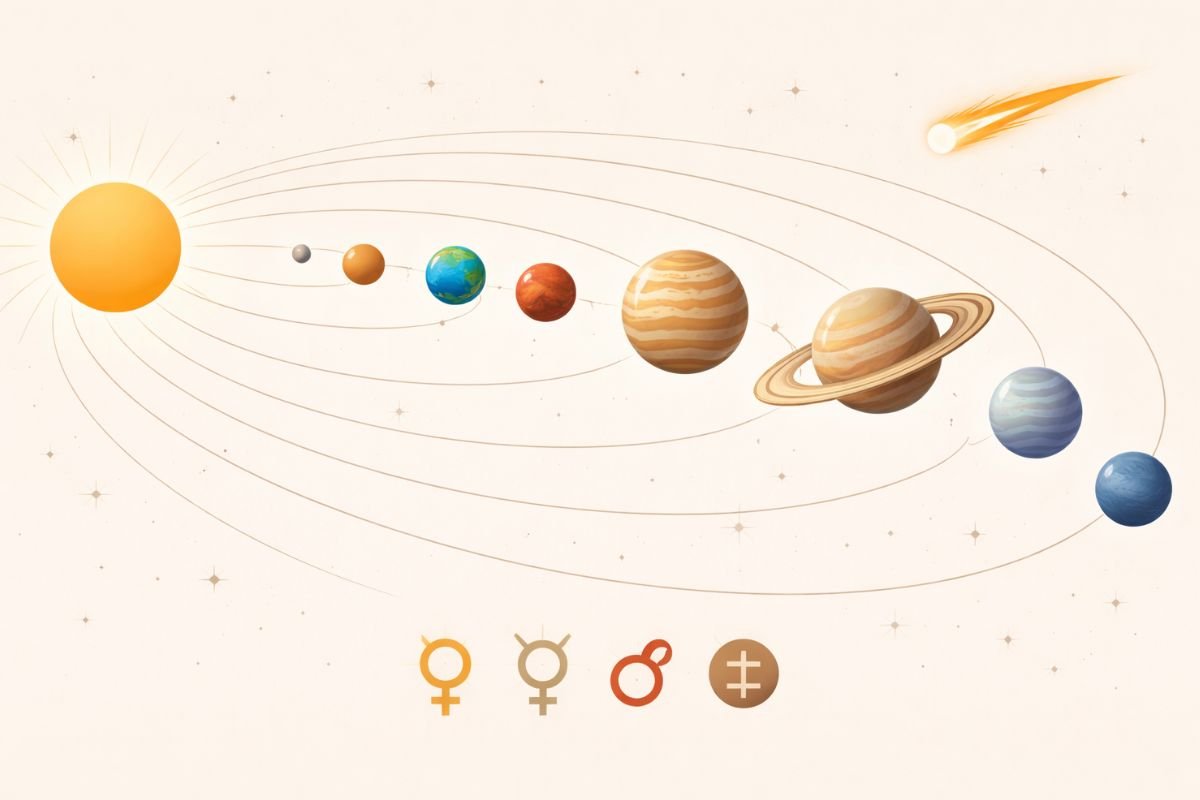
Your natal chart represents a snapshot of the sky at the exact moment of birth. The planets, however, never remain frozen in those positions. They continue moving through the zodiac every single day. Planetary transits occur when these moving planets interact with the fixed placements in your birth chart. In practical language, transits astrology explained describe what is happening now compared to your original planetary blueprint.
For instance, if Venus occupied Capricorn when you were born, and Mercury moves through Capricorn today, Mercury is said to be transiting your natal Venus. That interaction may temporarily influence Venus-related themes such as relationships, pleasure patterns, or comfort responses. This is why many astrologers consider planetary transits astrology a timing mechanism rather than a prediction device.
Also read: Rising Sign Meaning: How Others See You
Definition of Planetary Transits
Planetary transits describe how current planetary positions form relationships with natal chart placements, influencing perception, mood, behaviour, and timing patterns.
Why Planetary Transits Matter in Astrology
Your birth chart outlines personality structure. Planetary transits and life timing explain activation cycles. They help clarify why motivation fluctuates, why patience shortens, why certain frustrations repeat, and why clarity appears inconsistently. Many people assume life changes must originate externally, yet astrology transits guide beginners toward recognising that perception shifts often precede visible events. Understanding planetary transits effects on personality allows you to contextualise fluctuations rather than personalise them unnecessarily.
How Planetary Transits Affect Daily Life
Most transits do not manifest as dramatic events. They appear behaviourally. You may notice increased overthinking during Mercury phases, lowered tolerance during Mars periods, emotional sensitivity during Moon shifts, or gradual pressure accumulation during Saturn cycles. These changes rarely feel theatrical. They feel subtle, psychological, and often confusing when misunderstood. Planetary transits effects commonly appear as mood variations, reaction changes, communication shifts, motivation cycles, decision clarity fluctuations, and altered tolerance levels.
Inner Planet vs Outer Planet Transit Effects
Planetary speed directly influences duration. Fast-moving planets such as the Moon, Mercury, Venus, Sun, and Mars produce shorter behavioural atmospheres lasting days or weeks. These transits influence mood, communication style, social interaction patterns, and energy rhythms.
Slow-moving planets including Jupiter, Saturn, Rahu, and Ketu, shape longer psychological chapters. Their effects unfold gradually, often correlating with structural shifts, prolonged reassessment phases, and noticeable life pattern adjustments. This distinction explains why inner planet vs outer planet transit effects feel fundamentally different.
How Planetary Transits Work in Your Chart

Transit influence depends on context. Which planet is moving determines the thematic focus. Which natal placement is activated shapes psychological expression. Which house is involved defines the life area affected. A Mars transit to Mercury may increase reactivity in communication. A Venus transit to Moon may heighten emotional sensitivity. A Saturn transit to Sun may alter confidence and pressure perception. Identical planets produce very different experiences depending on chart interaction. This is central to how to interpret planetary transits realistically.
Signs Your Planetary Transits Are Active
Beginners often ask how transits affect life in recognisable ways. Common indicators include unexplained mood shifts, altered reaction thresholds, repeated situational themes, unusual impatience, temporary confusion cycles, sudden clarity phases, or noticeable behavioural deviations from baseline tendencies. Transit awareness functions as pattern recognition rather than event anticipation.
How to Track and Interpret Planetary Transits Practically
You do not need complex calculations initially. Observation provides the most reliable entry point. Tracking mood patterns, noting reaction changes, identifying repeated themes, and recognising timing fluctuations builds intuitive familiarity with understanding planetary transit timing. Astrology becomes practical when it explains lived experience rather than abstract theory.
Also read: Mars in Aquarius 2026: Restless vs Clear Signs
FAQ: Planetary Transits Explained
1. What are planetary transits in astrology?
Planetary transits describe how moving planets interact with natal chart placements, influencing behaviour and perception patterns.
2. How long do planetary transits last?
Duration varies by planetary speed. Moon transits last days, Saturn transits may extend across years.
3. Do planetary transits predict events?
Transits influence psychological and behavioural tendencies rather than guaranteeing fixed outcomes.
4. Which planetary transits feel strongest?
Transits involving the Sun, Moon, Ascendant, or slow-moving planets tend to feel more noticeable.
5. How to interpret planetary transits accurately?
Context matters. Planet involved, natal placement activated, and house affected shape experience collectively.
Planetary transits represent astrology’s timing logic. Your natal chart outlines structural design. Transits reveal activation cycles. Some periods encourage momentum. Others invite reassessment. Others alter perception thresholds. None operates randomly when viewed through behavioural patterns. Once you understand planetary transits astrology through lived experience, fluctuations begin to feel less chaotic and more cyclical. Astrology shifts from superstition toward structured observation.
Ask Agastyaa on AstroSure.ai for personalised planetary transit insight
Want personalised cosmic guidance?
Download AstroSure and chat with Agastyaa AI for insights tailored to your birth chart.
Download AstroSure