Rashi Compatibility: The Complete Vedic Guide to Love and Marriage
Have you ever wondered why some relationships feel effortless, while others feel like an emotional rollercoaster? You might meet someone who looks perfect, yet the connection drains you. Then, you meet someone totally unexpected, and the bond feels like magic. In today’s modern dating world, we often blame these dynamics on “chemistry” or “timing.” However, Vedic astrology offers a much deeper explanation: your Rashi compatibility.
In Vedic astrology, Rashi compatibility (also known as Rashi Melan or Kundali Milan) is the foundational check before considering marriage or any serious long-term partnership. It is not just about deciding who you will fall in love with; it is about understanding the natural, energetic match between two people’s minds. To make this all easier for you, we break down how this ancient system works, why your Moon sign matters more than your Sun sign in love, and how to understand your relationship’s true astrological blueprint.
Why Your Moon Sign Matters in Love
If you follow Western astrology, you are likely used to looking at your Sun sign (based on your birth month). Your Sun sign represents your ego, identity, and outward personality. However, in Indian astrology, the spotlight shifts to your Moon sign, or your Rashi. The Moon governs your mind, your deepest emotions, and your inner life. It dictates how you feel, how you react to stress, how you show affection, and how you heal after an argument.
Because relationships are emotional, the Moon sign is the ultimate deciding factor. Two people with compatible Sun signs but clashing Moon signs will often struggle in their day-to-day lives. Conversely, two people with strong Moon sign compatibility will emotionally feel “at home” with each other, even if other parts of their charts are not perfect. To understand your own Moon sign better, explore what your birth chart reveals about your hidden strengths.
The Basics of Marriage in Vedic Astrology
Before we even look at points and scores, an astrologer examines the architecture of your birth chart (Janam Kundali).
- The 7th House: In any natal chart, the 7th house governs marriage, partnerships, and long-term commitments. It reveals the exact dynamics of your marital life. A strong 7th house lord indicates a relationship filled with mutual respect and harmony.
- Planetary Friendships: Planets have natural friends and enemies. For relationships to succeed, the lord of your 7th house and Venus (the planet of love) should be friendly or neutral to each other. For example, if your 7th house is ruled by Mars, and your partner’s key planets are ruled by Mercury (a natural enemy to Mars), communication challenges may arise. Understanding these planetary friendships helps you navigate conflict with patience rather than frustration.
The 36-Point Ashtakoot System Explained Simply
When looking for Rashi compatibility for marriage, astrologers traditionally use the Ashtakoot system (known as Porutham in South India). This system evaluates eight different categories (koots) that add up to a total of 36 points (Guna Milan). Generally, a score of 18 or above is acceptable for marriage. A score of 24 or more is very good, and 30 or above is excellent. Anything below 18 is typically advised against. Here is what those eight koots actually measure:
- Varna (1 point): Measures spiritual and intellectual compatibility. It ensures that both partners have aligned egos and a mutual understanding of life’s work.
- Vashya (2 points): Checks attraction and influence. A good Vashya score means both partners can gently influence each other without one dominating the relationship.
- Tara (3 points): Evaluates birth star (nakshatra) compatibility. It marks shared destiny, good health, and longevity for both partners.
- Yoni (4 points): Examines physical, sexual, and instinctive compatibility. Nakshatras divide into animal symbols (like horse, elephant, tiger). This koot ensures your natural, intimate instincts align rather than clash. For a deeper dive, read our complete guide to Yoni matching in Kundali.
- Graha Maitri (5 points): Checks if the two Moon sign lords are friends. This is incredibly important. The lords of your minds must get along for you to truly understand one another.
- Gana (6 points): Divides temperaments into Deva (divine), Manushya (human), and Rakshasa (intense/instinct-driven). Same-temperament matches flow naturally, while mixed ones require conscious effort.
- Bhakoot (7 points): Examines the astrological distance between the two Rashis. Certain distances (like 6-8 or 2-12) are considered challenging for financial or emotional health.
- Nadi (8 points): Carrying the highest weight, this koot checks genetic and health compatibility. Partners having the same Nadi are traditionally considered unfavourable for progeny and long-term health. For more detail on this critical koot, read our guide on Nadi Dosh in Kundli.
Also read: Kundli Matching: What a Marriage Compatibility Report Actually Tells You
A Quick Way to Check Compatibility Using Elements
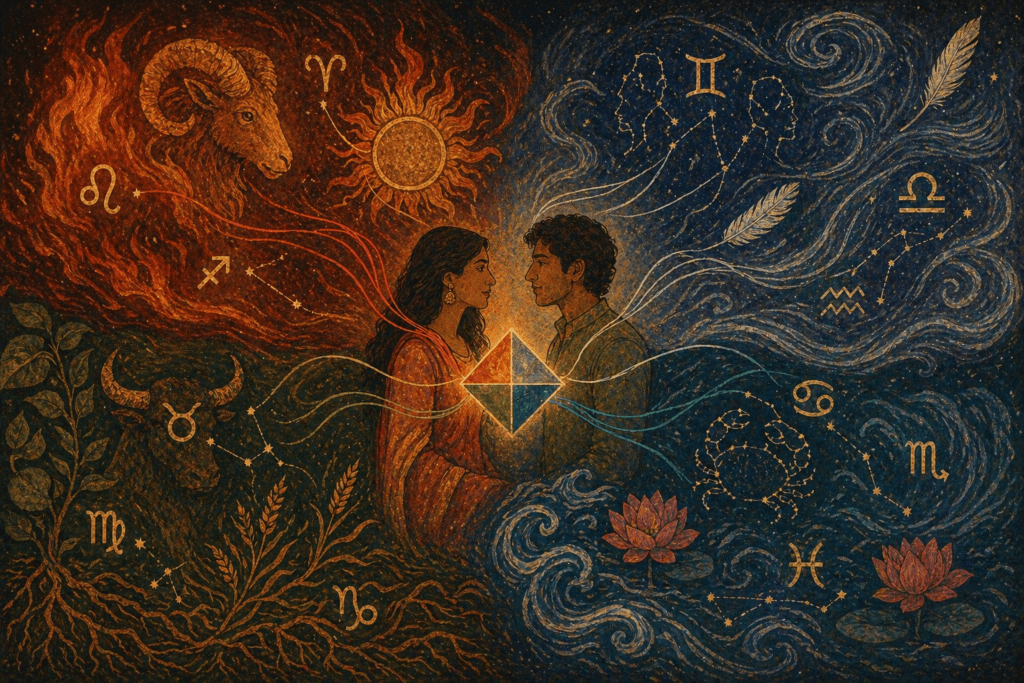
If you want a quick read on your zodiac sign compatibility before diving into a full 36-point analysis, look at the natural elements. Every Rashi belongs to Fire, Earth, Air, or Water.
- Fire (Aries, Leo, Sagittarius) + Air (Gemini, Libra, Aquarius): Fire needs air to burn. This is a highly energetic, mutually inspiring match.
- Earth (Taurus, Virgo, Capricorn) + Water (Cancer, Scorpio, Pisces): Water nourishes earth, and earth contains water. This creates a grounded, emotionally supportive, and highly stable relationship.
- Fire + Water: Passionate, but potentially destructive. Fire evaporates water, and water extinguishes fire.
- Earth + Air: A practical disconnect. Air moves right past Earth, often resulting in parallel lives with growing emotional distance.
What Each Rashi Needs in Love
Beyond points and elements, every Rashi brings a unique love language to the table. Here is what each Moon sign looks for in a partner, and what they offer in return.
Aries to Virgo

Aries (Mesha Rashi): Aries wants passion, honesty, and a partner who can match their high energy. In return, they offer fierce loyalty, protection, and the courage to always show up. Best matches: Leo, Sagittarius, Gemini.
Taurus (Vrishabha Rashi): Taurus seeks emotional security, consistency, and a partner who values comfort. In return, they offer deep, dependable love, practical support, and a beautiful home life. Best matches: Virgo, Capricorn, Cancer.
Gemini (Mithun Rashi): Gemini needs mental connection, witty conversation, and variety. In return, they offer lightness, humour, endless fascination, and a mind that genuinely engages with yours. Best matches: Libra, Aquarius, Aries.
Cancer (Karka Rashi): Cancer requires absolute emotional safety, nurture, and a strong sense of family. In return, they offer unconditional care, deep intuition, and a love that acts as a safe harbour through any storm. Best matches: Scorpio, Pisces, Taurus.
Leo (Simha Rashi): Leo wants admiration, loyalty, and a partner who is proud of them. In return, they offer royal treatment, unwavering devotion once committed, and a relationship that feels like a constant celebration. Best matches: Aries, Sagittarius, Libra.
Virgo (Kanya Rashi): Virgos look for reliability, intelligence, and someone who respects the details. In return, they offer devotion shown through a thousand small acts of service, meticulous care, and grounding loyalty. Best matches: Taurus, Capricorn, Scorpio.
Libra to Pisces

Libra (Tula Rashi): Libra thrives on partnership, balance, and aesthetic harmony. In return, they offer a true team-player mindset, beautiful romance, and a constant willingness to compromise. Best matches: Gemini, Aquarius, Leo.
Scorpio (Vrishchika Rashi): Scorpios demand depth, intensity, and complete emotional transparency. In return, they offer a transformative love that goes all the way, fierce protection, and a commitment that can outlast a lifetime. Best matches: Cancer, Pisces, Capricorn.
Sagittarius (Dhanu Rashi): Sagittarius values honesty, adventure, and emotional freedom. In return, they offer expansive love, profound philosophical conversations, and a joyful, optimistic life. Best matches: Aries, Leo, Aquarius.
Capricorn (Makar Rashi): Capricorns approach love seriously, seeking stability, shared ambitions, and mutual respect. In return, they offer rock-solid lifetime commitment, material security, and a love that actually grows warmer with age. Best matches: Taurus, Virgo, Scorpio.
Aquarius (Kumbh Rashi): Aquarius values intellectual freedom, individuality, and friendship. For them, a lover must first be a best friend. In return, they offer absolute loyalty, respect for your independence, and an unconventional but profound bond. Best matches: Gemini, Libra, Sagittarius.
Pisces (Meena Rashi): Pisces seeks a soulful, romantic, and compassionate connection. In return, they offer unconditional empathy, spiritual partnership, and the rare ability to see and love your innermost soul. Best matches: Cancer, Scorpio, Taurus.
What This System Does Not Tell You
While the 36-point Kundali Milan is a brilliant tool, it is not the entire picture. Relying purely on an Ashtakoot score can mislead you if you ignore the rest of the natal chart. Here are the red flags and specific checks that Rashi compatibility alone misses:
- Manglik Dosha: If Mars occupies the 1st, 4th, 7th, 8th, or 12th house of a birth chart, the person has Mangal Dosha. A high Ashtakoot score cannot cancel this out. Typically, traditional astrology advises that two Manglik partners balance each other perfectly.
- Shadashtak: If the bride and groom’s Moon signs are 6 and 8 signs apart, it forms a challenging angle that can create persistent friction, even if the overall points are decent.
- The Navamsa Chart (D9): The main birth chart shows the promise of marriage, but the Navamsa chart shows the actual texture and reality of married life. Two people can have a great 30-point match, but if their Navamsa charts clash, the marriage will feel much harder than expected.
- Individual Chart Health: Even with a perfect 36 out of 36 score, if one partner’s chart shows severe afflictions regarding health, finances, or the 7th house itself, the marriage will still face immense hurdles. Compatibility cannot override individual destiny.
For a broader understanding of how doshas affect your life, read our guide on 6 Kundli doshas that may be secretly running your life.
A More Realistic Way to Look at Compatibility
Rashi compatibility is a lens, not a final verdict. It is crucial to remember that astrology does not replace human effort; it merely guides it. Two people with a spectacular 32-point score who lack emotional maturity, refuse to communicate, and take each other for granted will inevitably struggle. On the flip side, two people with a mediocre 18-point score who communicate openly, work on their own emotional baggage, and consciously choose each other every single day can build an incredibly beautiful life together.
The Vedic system gives you vital information. It highlights your natural energetic patterns, shows you where friction is most likely to occur, and reveals the areas where you will both need to put in extra effort. It maps the weather of your relationship, but you are the ones who must sail the ship.
Also read: Can Astrology Help With Compatibility Issues? A Complete Guide
Rashi Compatibility FAQs
1. What is Rashi compatibility in simple terms?
It is a way of checking how well two people match emotionally based on their Moon signs. It focuses more on feelings and daily behaviour than just personality.
2. Is the 36-point system always accurate?
It is helpful, but not complete. It gives a basic idea of compatibility, but other parts of the chart and real-life behaviour matter just as much.
3. What is a good compatibility score for marriage?
Anything above 18 is usually acceptable. Scores above 24 are strong, but they do not guarantee a perfect relationship.
4. Can two people with low compatibility still work out?
Yes. If both people communicate well and put in effort, they can build a strong relationship even with a lower score.
5. What if we have Manglik Dosha or Nadi Dosh?
These doshas require specific remedies and deeper chart analysis. A high Ashtakoot score alone cannot cancel them out. Read our detailed guides on Mangal Dosha and Nadi Dosh for remedies and exceptions.
Ask Agastyaa if your match is truly compatible
Want personalised cosmic guidance?
Download AstroSure and chat with Agastyaa AI for insights tailored to your birth chart.
Download AstroSure