Why Is Ganga Jal Considered Sacred Even After Years?
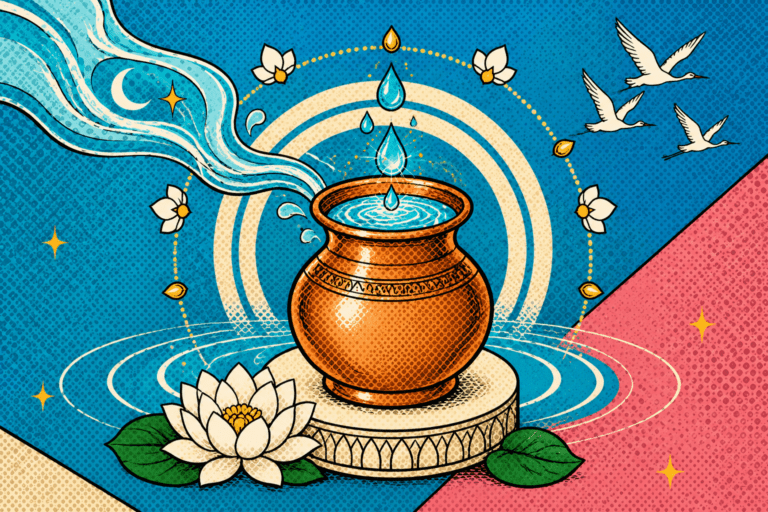
Ask almost any Hindu family to name the most sacred water they know, and the answer will always be the same: Gangajal. Indeed, it has been an essential part of Hindu life for centuries. Specifically, it is used in daily pujas, weddings, housewarming ceremonies, festivals, and even in a person’s final moments. Therefore, families carefully preserve it for years, sometimes even decades, and use only a few drops at a time. Most of us simply accept this as tradition. However, we rarely stop to ask why this specific river came to hold such an extraordinary place in Hinduism. Ultimately, the answer goes far beyond the water itself. It is a deep story of faith, ancient mythology, history, and even a few scientific discoveries that continue to surprise researchers today. Let us explore the real reasons behind this enduring practice.
Quick Glance: Why Gangajal Is Considered Sacred
- First, Gangajal is regarded as sacred because Hindu tradition associates the Ganga with Lord Shiva, purification, and moksha.
- Furthermore, it is used in pujas, weddings, housewarming ceremonies, festivals, and final rites as a symbol of blessings and spiritual purity.
- Interestingly, studies have found unusual natural properties in water from parts of the Ganga, but these do not completely explain its religious significance.
- Finally, many families preserve Gangajal for years because it remains an important part of both tradition and family rituals.
Why Is the Ganga Considered Sacred?
In Hindu tradition, the Ganga is much more than just a river. Actually, she is worshipped as Ganga Mata, a living goddess whose waters are believed to purify both body and mind. One of the best-known stories comes from King Bhagiratha. According to the Puranas, he performed years of intense penance. His ultimate goal was to bring the heavenly Ganga to earth so his ancestors could attain moksha. However, the force of her descent was so powerful that it would have destroyed the earth. Therefore, Lord Shiva stepped in. He received the river in his matted locks, slowing her fall before safely allowing her to flow gently across the land. For devotees, this ancient story beautifully explains why Gangajal is unlike any other water. It is remembered as water that first passed through Lord Shiva before ever reaching the earth. Consequently, this makes it a timeless symbol of purity, blessings, and liberation.
Also Read: Vedic Astrology Remedies: Understanding Spiritual Practices
Why Is Gangajal Used in Hindu Rituals?
Gangajal appears in almost every important stage of Hindu life. For example, it is sprinkled during pujas, weddings, naming ceremonies, and housewarming rituals. Furthermore, it is used before many families begin something completely new. Usually, a priest uses only a few drops, because the ritual is symbolic rather than physical. Essentially, the water marks the beginning of something sacred. It gently reminds devotees to approach the moment with deep respect and devotion. Additionally, one of its most meaningful uses comes at the very end of life. Many families respectfully place a few drops of Gangajal in the mouth of a loved one during their final moments. Ultimately, it is offered as a quiet prayer for peace and a reminder of the soul’s journey towards moksha.
What Does Science Say About Gangajal?
This is probably the most common question people ask. Many believe Gangajal never changes, no matter how long it is stored. However, that is not entirely true. Like any natural water, it can be affected by contamination or poor storage. At the same time, scientists have found that water collected from certain stretches of the Ganga has some very unusual natural properties. For instance, as early as 1896, British bacteriologist Ernest Hankin observed that Ganga water showed antibacterial activity. Later studies found naturally occurring bacteriophages. These are special viruses that destroy bacteria but do not affect humans at all.
Moreover, researchers have also studied the river’s mineral content and its unique ability to retain dissolved oxygen in some stretches. These distinct findings may help explain why properly stored Gangajal often remains clear for a remarkably long time. While they do not fully explain its sacredness, they do show that the river has rare qualities that continue to interest scientists today.
Also Read: 5 Ancient Indian Practices to Help You Feel Calm Every Day
Why Do Hindus Keep Gangajal at Home?
For many families, Gangajal is not kept because they expect to use it every single day. Instead, it is kept because they know there will be important moments when they will reach for it. A new home. A festival. A child’s birth. A wedding. Perhaps they need a quiet prayer before an important decision. Or, sadly, a final farewell to a loved one. Over time, the small bottle simply becomes part of a family’s memories just as much as its rituals. That is perhaps why Gangajal continues to hold such a special, irreplaceable place in Hindu homes. Science can certainly explain some of its natural properties, but faith gives it a meaning that has been passed from one generation to the next. Even after years, those few drops continue to remind millions of people of the exact same thing: that the sacred can be present in the simplest parts of everyday life.
Want to understand the spiritual significance of rituals in your life?
Ask Agastyaa. Download AstroSure and get 4 questions free.
FAQs About Gangajal
1. Why is Gangajal considered sacred in Hinduism?
Gangajal is considered sacred because the River Ganga is worshipped as Goddess Ganga. According to Hindu tradition, the river descended from heaven through Lord Shiva’s matted locks, making it a powerful symbol of purity, blessings, and spiritual liberation.
2. Does Gangajal really stay fresh for years?
Properly stored Gangajal often remains clear for a very long time. Researchers have found unique natural properties in water from certain stretches of the Ganga, but these findings do not completely explain its religious significance or mean that the water can never spoil.
3. Why is Gangajal used during the last rites?
Many Hindu families place a few drops of Gangajal in a loved one’s mouth during their final moments as a peaceful prayer for moksha. Ultimately, it symbolises spiritual purification and supports the soul’s journey.
4. Can Gangajal be kept at home?
Yes. Many families keep Gangajal at home for daily prayers, festivals, housewarming ceremonies, weddings, and other important religious occasions. Typically, it is safely stored in a clean, closed container.
5. Can I use Gangajal for daily puja?
Yes. Many devotees regularly use a few drops of Gangajal during daily worship to purify the prayer space or offerings. However, specific practices may naturally vary between different families and traditions.
Want personalised cosmic guidance?
Download AstroSure and chat with Agastyaa AI for insights tailored to your birth chart.
Download AstroSure