5 Indian Travel Superstitions We Still Follow (And The Real Reasons Why)

Anyone who grew up in an Indian household knows the familiar checklist before leaving for a trip. The suitcases are packed, the taxi is honking on the street, and you are running late. Yet, before you step out, a sequence unfolds. Your mother rushes over with a spoonful of sweet curd. Your father checks the clock to ensure the timing is right. You bend down to touch their feet, hoping you haven’t forgotten anything. Turning back is simply out of the question. We often dismiss these rituals as old Indian travel superstitions. But if you look closer, these practices hold layers of wisdom, astrological science, and common sense. Let us explore five common beliefs before travelling and uncover the beautiful logic hidden inside them.
Key Takeaways
- Many Indian travel superstitions began as practical habits that encouraged people to travel with greater care and awareness.
- These traditions are not just about luck. They remind us to slow down, prepare well, and begin every journey with a calm mind.
- Vedic astrology adds another layer of meaning by linking these rituals with planetary energies and auspicious timing.
- Whether you follow these customs or not, they offer a simple lesson that still feels relevant today. The way you begin a journey often shapes the experience that follows.
The Meaning Behind Common Indian Travel Superstitions
1. The Spoonful of Curd and Sugar

The famous spoonful of dahi cheeni is like a requirement before a big exam, a job interview, or a long journey. Sometimes your mother feeds you, or you quickly eat it standing in the kitchen. From an Ayurvedic perspective, travel naturally stirs up the Vata dosha in your body. This creates feelings of restlessness, airiness, and anxiety. Curd is a naturally cooling food that strengthens the gut. Sugar provides a fast burst of energy. Together, they calm your nervous system before the journey even begins.
In Vedic astrology, curd is closely linked with the Moon. This planet is associated with emotions, comfort, and the feeling of home. Eating a little curd before you leave is believed to invite the Moon’s blessings for a safe and peaceful journey. The touch of sweetness also carries its own meaning. It is a simple way of beginning your journey on a positive and auspicious note. If you happen to be allergic to dairy, you can easily substitute this with a small piece of jaggery or fruit. The goal is simply a sweet, grounded beginning.
2. The Cat Crossing the Road
Seeing a cat cross the road right as you start your engine usually brings everything to a grinding halt. Some people wait for another car to pass first, while others sit in silence for a few minutes. In ancient times, wild cats carried very real diseases like rabies. A sudden encounter was a health warning from the environment to stay alert. Over time, this belief also found a place in Vedic astrology.
Cats, especially black or nocturnal ones, are often associated with Rahu and Ketu, the shadow planets. Ketu is linked with sudden pauses, unexpected events, and moments of awareness. So when a cat crosses your path, it is traditionally seen as a reminder to slow down, pay attention, and become more aware of what is happening around you.
The direction even matters. A cat crossing from left to right is seen as a strong signal to wait, while right to left requires just a mild caution. The traditional remedy for this is to just wait. Take a few deep breaths. Check your wallet and your tickets. That tiny moment of mindfulness forces you to reset your focus before hitting the highway.
3. Touching the Elders’ Feet
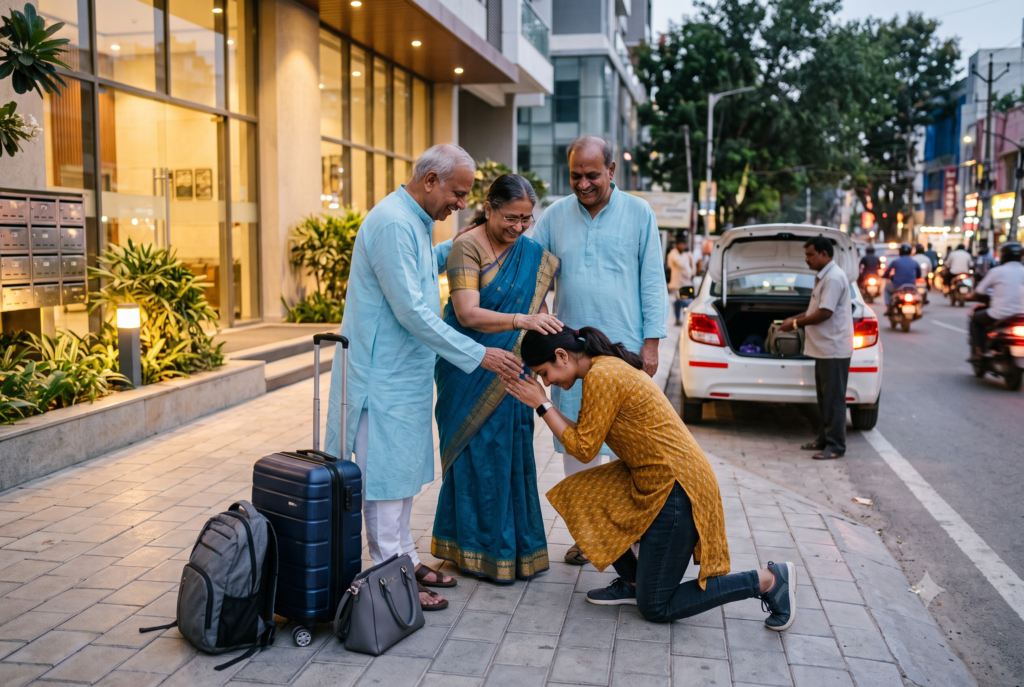
In our fast-paced modern world, we often leave for the airport while casually texting our parents a quick goodbye from the cab. The tradition of charan sparsh asks you to do the opposite. Before leaving, you pause, bow to your elders, and seek their blessings. It creates a quiet moment to acknowledge the journey ahead instead of rushing out the door. In Vedic tradition, touching an elder’s feet is a way of showing humility and receiving their blessings. It is also believed that elders carry the wisdom and good karma earned through a lifetime of right actions.
By seeking their blessings, you symbolically carry a small part of that strength and goodwill with you on your journey. In astrology, close family members are linked with some of the most supportive influences in your birth chart. Seeking their blessings before you leave is believed to strengthen those positive energies and send you on your way with their goodwill. If your family is far away, even a quick phone call before your journey carries the same intention.
Also Read: Why Is Lemon and Chilli Hung Outside Shops and Homes?
4. Avoiding Rahu Kaal
Many families still consult the daily almanac to avoid starting a trip during specific times of the day, particularly Rahu Kaal. Rahu Kaal is a 90-minute window that happens every single day, varying slightly based on the sunrise. It is ruled by the shadow planet Rahu, which governs illusions, obstacles, and things going strangely off course. Over generations, people noticed a pattern. Journeys that began during this particular window were believed to face more delays, obstacles, or unexpected changes.
Whether you see it as an astrological influence or simply a tradition that encourages a moment of caution, the advice remains the same: do not rush. During periods like Mercury retrograde, when travel and communication are already believed to be more unpredictable, taking a short pause before starting your journey is thought to bring greater peace of mind.
5. Never Turning Back for a Forgotten Item

You have locked the door, taken ten steps down the driveway, and suddenly realised you forgot your sunglasses or your phone charger. Traditional Hindu travel rituals strictly warn against unlocking the door and going back inside. From a practical point of view, rushing back into the house after forgetting something can leave you feeling flustered and distracted. Your mind is juggling the forgotten item, the time you have lost, and the journey ahead. Setting off in that state makes it easier to miss a turn or make a careless mistake.
Astrologically, Mercury rules small objects and our daily memory. Forgetting things happens most often when our mind is scattered. Returning home breaks the energetic seal of your departure. In traditional belief, going back into the house after you have already left breaks the flow of your journey. If you have to return for something important, the advice is simple. Sit down for a minute, drink a little water, and then leave again. It gives your mind a chance to settle and lets you start your journey with a fresh sense of calm.
Bonus Tradition: Understanding Dishashool
Another tradition many families still follow is checking the direction of their journey before leaving home. In Vedic astrology, certain directions are considered less favourable on specific days. This belief is known as Dishashool. For instance, travelling East is avoided on Mondays and Saturdays, while Thursdays are considered tough for heading South. Every direction is ruled by a specific planet and deity in Vedic astrology. When you travel against the recommended grain, you are essentially swimming against the day’s cosmic current.
Today, most people cannot postpone a journey because of Dishashool. Instead, the tradition offers a simple remedy. Before you leave, eat a small amount of the food linked to the direction you are travelling. For example, eating a little jaggery before heading south on a Thursday is believed to remove obstacles and help your journey go more smoothly.
The Hidden Wisdom of Thresholds
When you look at these Indian travel superstitions together, a clear pattern begins to emerge. They all encourage you to slow down before you leave. A journey is more than getting from one place to another. It marks the start of something new. Older generations understood that if you begin in a rush, you are more likely to carry that rush with you. A spoonful of something sweet helps you pause. Waiting for a cat to pass reminds you to pay attention. Checking Rahu Kaal makes you think before you set off. Taking your elders’ blessings grounds you before you leave home.
Seen this way, these customs are less about superstition and more about mindfulness. In a world of one-click bookings, online check-ins, and hurried goodbyes, they remind us to pause and leave with intention. Perhaps that is what our grandparents were trying to teach us all along: the way you begin a journey often shapes the journey itself.
Planning a journey soon?
Ask Agastyaa on AstroSure for personalised travel guidance. Get 4 free questions.
Travel Superstitions FAQs
1. Why do Indians eat curd and sugar before travelling?
Dahi cheeni is believed to bring good fortune and a calm start to an important journey. Ayurveda also considers it a nourishing combination that helps settle the body before travel.
2. What is Rahu Kaal and should you avoid travelling during it?
Rahu Kaal is a daily 90-minute period that is traditionally considered less favourable for starting new activities. While many people still avoid beginning a journey during this time, others see it as a reminder to travel with extra care rather than fear.
3. Why is turning back after leaving home considered inauspicious?
Traditional belief says that returning home after setting out interrupts the flow of the journey. On a practical level, it can also leave you feeling rushed and distracted before travelling.
4. What is Dishashool in Vedic astrology?
Dishashool is the belief that certain directions are less favourable for travel on specific days of the week. Traditional remedies are often suggested when postponing the journey is not possible.
5. Why do people touch their elders’ feet before travelling?
Seeking an elder’s blessings is seen as a way of receiving their goodwill, wisdom, and positive energy before beginning an important journey.
Want personalised cosmic guidance?
Download AstroSure and chat with Agastyaa AI for insights tailored to your birth chart.
Download AstroSure