Why Is a Black Thread Tied Around the Ankle? Meaning Explained
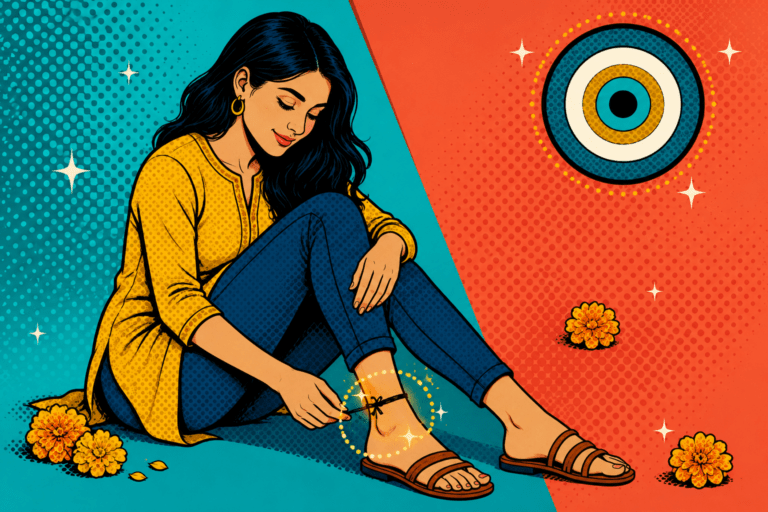
You have probably noticed it. A small baby at a family gathering, a college student on the train, or maybe even your own grandparent. Look closely at their feet, and you will often see a simple black thread around the ankle. Indeed, it is such a common sight in Indian households that we rarely stop to ask why we do it. Is it just an old habit? Is it a religious rule? Or does it actually do something? We often hear that it protects people from the evil eye, or ‘nazar’. However, the real reasons behind this tradition are much more layered. Let us look at how this custom started, the beliefs attached to it, and what it really means when someone wears a black thread around the ankle.
Quick Glance: Black Thread Around the Ankle
- A black thread around the ankle is traditionally worn as a symbol of protection against nazar or the evil eye.
- The thread itself is not believed to have magical powers. Its meaning comes from intention, faith, family traditions, and blessings.
- Many people wear it on the ankle because it symbolises grounding, protection, and life’s journey.
- Astrology may recommend a black thread in specific birth charts, but it is not a universal Vedic rule or remedy.
- Whether worn for faith or comfort, the tradition continues because it offers many people a sense of reassurance and connection.
Does a Black Thread Really Protect Against Nazar?
Many people assume the cotton thread itself has some kind of magical power. However, traditional belief actually says something different. In reality, the thread is just a symbol. It represents a protective intention or a blessing from a loved one. Therefore, it only becomes meaningful because of the prayer, the intention, the faith, and the tradition behind it. Ultimately, the plain cotton string is not inherently powerful on its own.
Why Do We Use Black?
This is one of the most common questions people ask. In Indian culture, black has two opposite meanings. Usually, we avoid it during auspicious ceremonies like weddings or pujas. Yet, it is the main colour deliberately used against nazar. Why? Traditional belief suggests that bright colours attract attention, while black absorbs it. So, black symbolically draws attention away from the wearer, making it one of the most common colours used in nazar remedies. Furthermore, different colours express different intentions. A red thread usually represents blessings and devotion. Yellow is for wisdom and auspiciousness. White stands for purity. Finally, black is specifically for protection and absorbing unwanted attention.
Why Is the Black Thread Worn Around the Ankle?
Most people know about tying protective threads on the wrist, so why do we use the ankle for the black thread? There are a few traditional explanations, and they are quite interesting.
First, it stays hidden. Unlike a bright wristband, the ankle thread is less visible. Many traditions believe protection works best when it is quiet. Therefore, it is not meant to be jewellery; it is a subtle reminder.
Second, the feet constantly touch the earth. In Indian tradition, the earth is associated with stability, grounding, balance, and absorbing excess energy. Thus, some traditions see the ankle as a suitable place for protection because it remains close to the ground.
Third, ankles represent movement. They allow us to walk and move forward, which symbolises life’s journey. Consequently, the thread may not only protect the person. It symbolically protects the path they walk.
Left Ankle or Right Ankle?
If you search online, you will find endless debates about which leg is the correct one. Some beliefs say women should wear it on the left ankle and men on the right ankle. Conversely, other traditions say either ankle is perfectly acceptable. In truth, there is no single rule deciding which ankle must be used. Family traditions often differ. Sometimes, an astrologer might recommend a specific side depending on why you are wearing it, but there is no universal rule you have to stress over.
Why Do Babies Wear a Black Thread Around the Ankle?
Naturally, babies attract a lot of attention. Family members, friends, and even strangers often stop to admire them. In many Indian homes, babies are also believed to be more sensitive to the evil eye. That is why you may see a small black dot, a black thread, or a black bead tied around them. For many families, these are not just traditional nazar remedies. Additionally, they also bring parents and grandparents a sense of comfort and reassurance as they take the baby out into the world.
Is Wearing a Black Thread Mentioned in the Vedas or Astrology?
You might wonder if wearing a black thread is a rule mentioned in the Vedas or other Hindu scriptures. Not exactly. There is no direct instruction that says everyone should tie a black thread around the ankle. Instead, the practice mostly comes from family traditions, regional customs, and, in some places, Tantric practices that have been followed for generations.
Astrology can sometimes play a role too. An astrologer may suggest wearing a black thread as a remedy for a specific birth chart, but it is not something recommended for everyone. Black is traditionally associated with Shani (Saturn), so the thread is sometimes worn as part of Saturn-related remedies that are believed to encourage qualities like discipline, patience, and steadiness. However, simply wearing a black thread does not automatically please Saturn. It is merely one small part of a remedy and should always be understood in the right context.
What Happens If a Black Thread Breaks?
You might notice that some threads have specific numbers of knots, like seven, nine, or eleven. Different traditions explain these differently. Some traditions interpret nine knots as representing the Navagraha (the nine planets) or a sense of completeness, while others follow family customs without attaching a specific symbolic meaning. Seven knots might represent the seven chakras or sacred rivers. What happens when it breaks? People often panic, thinking something terrible is about to happen. In reality, cotton threads naturally weaken, become loose, and break over time. In many families, a broken black thread is simply replaced without fear. Rather than treating it as a bad omen, it is often seen as the end of that thread’s use.
So, does a black thread actually remove nazar? There is no scientific evidence that it can. Its importance comes from cultural and spiritual traditions, where it is worn as a symbol of protection. For many people, it is also a quiet reminder of faith and a source of comfort and reassurance.
The Psychology of Protection
There is a very real psychological benefit to this tradition. Protective rituals naturally reduce anxiety. A person wearing the thread may feel calmer, protected, and spiritually supported. Moreover, they feel connected to the family member who tied it for them. The physical object becomes less important than what it represents. Sometimes protection begins with believing that you are not facing life’s uncertainties alone.
Common Myths About Wearing a Black Thread
Before we finish, let us clear up a few common myths. Many believe only children should wear the thread, but adults wear it just as often. Some think it only works if it is blessed by a priest, but many families tie it themselves at home while saying a simple prayer. Lastly, some assume it is a compulsory rule in Hinduism. In fact, it is completely optional.
Today, you will see designer black threads or black bead anklets sold in stores. For some people, the spiritual meaning is still very much alive. For others, it is simply a fashion statement. But whether it is worn for tradition or style, the black thread around the ankle remains a quiet, familiar part of our culture.
Looking for the right spiritual remedy for your birth chart?
Ask Agastyaa. Download AstroSure and get 4 questions free.
FAQs About Wearing a Black Thread Around the Ankle
1. Does wearing a black thread really protect against the evil eye?
Many families believe a black thread helps protect against nazar or the evil eye. However, there is no scientific evidence that it can prevent negative events. Its significance comes from cultural traditions, faith, and the intention behind wearing it.
2. Can anyone wear a black thread around the ankle?
Yes. Children and adults both wear black threads. Some people wear them as part of family traditions, while others follow advice from an astrologer or simply wear them as a personal symbol of protection.
3. What does it mean if a black thread breaks?
A black thread usually breaks because cotton naturally wears out with time. In many families, it is simply replaced. It is not universally considered a bad omen.
4. Is wearing a black thread compulsory in Hinduism?
No. Wearing a black thread is a cultural and regional practice rather than a compulsory religious rule. Many Hindus wear one, while many others do not.
5. Can I wear a black thread for fashion instead of religious reasons?
Yes. Today, many people wear black thread anklets purely as jewellery or fashion accessories. Others continue to wear them because of family traditions or spiritual beliefs.
Want personalised cosmic guidance?
Download AstroSure and chat with Agastyaa AI for insights tailored to your birth chart.
Download AstroSure